
Border Print vs All-Over Print: Which Tablecloth Works Better?
A border print draws a line around the table. An all-over print carries the same rhythm across the top and down the sides. To decide between them, look at what will still be visible once the plates, chairs and serving dishes are in place.
Look in three places: centre, fold and hem
Find three parts of the cloth in the same product photograph. The centre is where a platter or vase will sit. The fold is the point where the textile leaves the tabletop. The hem is the finished edge, not necessarily the last printed line. A repeat can fill most of the field and still have a border. A scene can live mainly on the hanging sides. Look closely enough to see which part you are buying for.
Choose a border if you like a defined edge that is still visible when the centre is busy. Choose an all-over repeat if you want a fragment of the design visible almost anywhere a plate leaves space. A large central motif is a third choice: lovely on a bare table, but plan whether the serving dish will sit over it. It is the arrangement of the artwork, not the fibre name, that decides where the motif appears.
What three catalogue views reveal
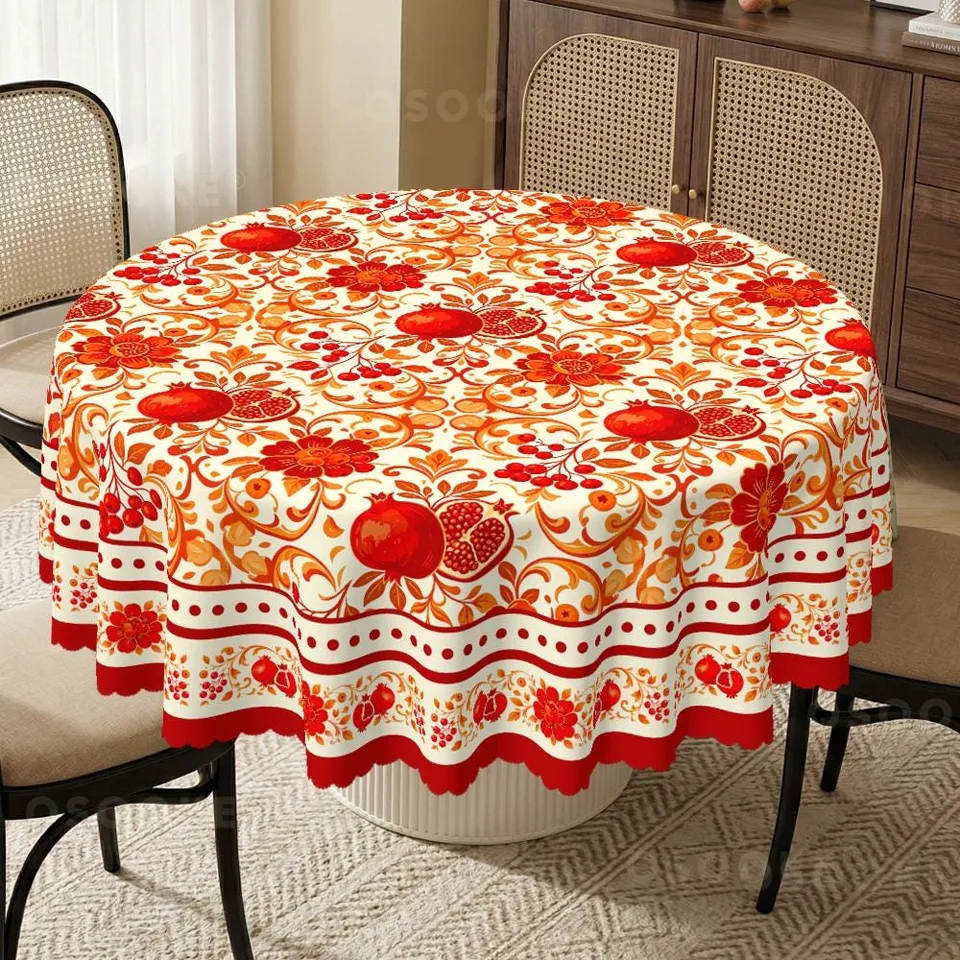
A repeat plus a frame
The Mediterranean Pomegranate Floral Tablecloth has fruit across the top as well as distinct red bands near the hem. The fruit fills the gaps between plates; the border reads as a continuous rhythm from the room. If that lower band is why you like the design, check how much drop your chairs actually leave visible from the doorway.
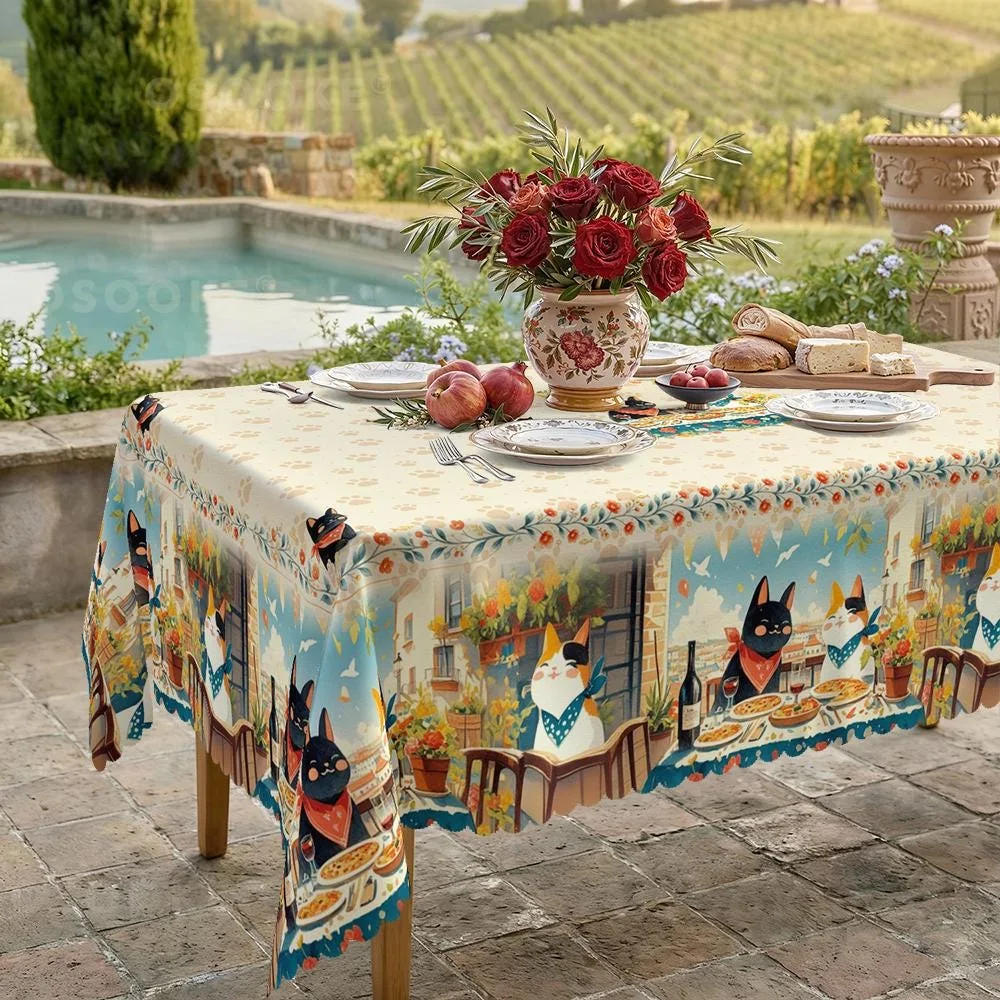
A narrative on the hanging side
The Cat Café and Pizza Street Scene Tablecloth is quieter across the upper field than below the edge. From the illustrated side, the café scene stays visible even with dishes on top. From directly above, much of that narrative is out of sight. Decide which side faces the room before you centre the cloth: the side you first see need not be the one shown in the listing photograph.
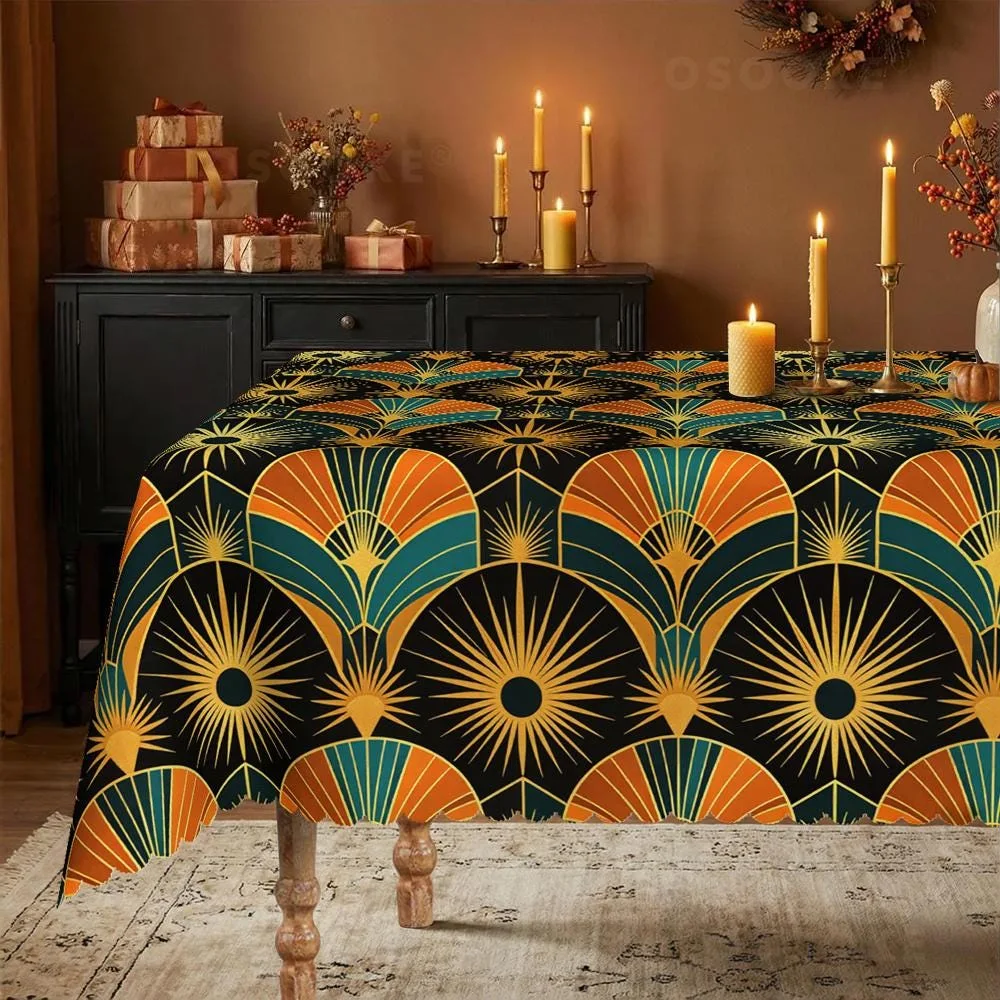
One pattern across the fold
The Art Deco Sunburst Tablecloth repeats its fans across the surface and down the sides. A platter may cover a few fans, but it does not cover the only one. An all-over repeat still has a scale: on a narrower table, slip a plain plate into the space between the busiest lines to see how many full shapes remain.
Will the border hang below the table or sit on top?
Ask for two measurements on the exact shape and size you are considering: the finished size and the distance from the hem to the inner edge of the printed band. Start with a centred cloth. Subtract the tabletop width from the cloth width, then divide by two to find the drop along each long side. Compare that number with the band measurement.
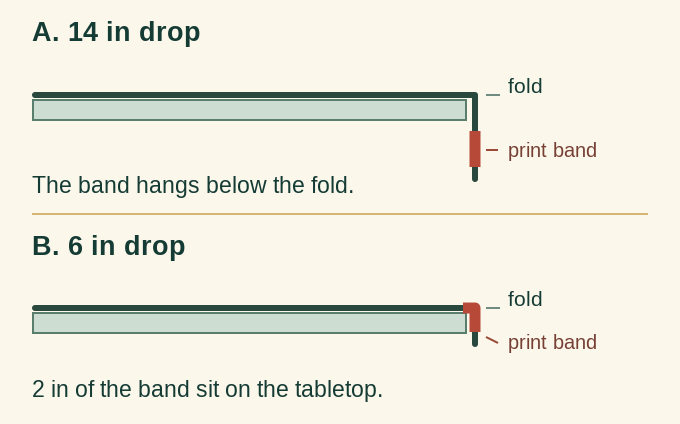
Say the cloth is 70 inches wide. On a 42-inch table, the drop is (70 − 42) ÷ 2 = 14 inches. Since the band's upper edge is 8 inches from the hem, that edge hangs 6 inches below the fold. On a 58-inch table, the drop is only 6 inches. The upper 2 inches of the band now lie on the tabletop. Neither is wrong; the second fit deliberately frames the plates.
Measure the ends separately. A leaf that adds length can pull the printed band up onto the tabletop at the ends while leaving the side drop unchanged. On a round table use the diameter; on an oval, check the side and end drops separately. Do not assume a rectangle's band width applies to an oval cut or to a different size in the same listing.
Three checks before buying a patterned cloth
- Check both views. Look for a straight-on photo of the hanging side and a photo of the tabletop. A front view alone cannot tell you how much print will be under plates.
- Try the fold. Mark both edges of the band on a paper strip, measuring from the planned hem. Drape the strip over the tabletop edge. Place your widest plate by it and pull the chair forward. Now look at eye level from the doorway.
- Read the item option. Select the intended shape and finished size. A printed scallop or stitch in a photograph is not evidence of a woven, embroidered or scalloped hem; check the listing or ask for a close-up of the actual finish.
Keep reading
Would a narrow runner leave the right part visible?
Compare full coverage with a narrow strip, and see when layering hides a print.
Choose napkins for a patterned Christmas cloth →