
Does cotton feel softer than polyester at the table?
Not always. A brushed cotton can feel downy where a smooth polyester feels slick; a brushed polyester can feel softer than a starched cotton. And a tablecloth is not a shirt. Your sleeve moves with you for hours. At dinner, a few inches of cloth, held still by a hard edge, may be all your wrist ever knows of it.
When you say a cloth is soft, what did your hand just do?
Try this with a clean tea towel. Pinch a corner between finger and thumb: you can tell how readily it bends. Now lay it flat and draw the back of a finger across it. You might find a raised check or a line of stitching that you did not notice in the pinch. Finally, rest your wrist on it without moving. A cloth can pass the first test and lose you on the third. You have not changed your mind about the fabric; you have asked it three different questions.
Textile researchers call the impression a fabric gives when handled its hand. In a controlled comparison using both cotton and polyester, Geitel Winakor, Charles Kim and Leroy Wolins varied stiffness, roughness and thickness. The judges' ratings differed with all three properties and with fibre content. The label was not meaningless. It just could not tell the judges everything their hands could.
It helps to give “soft” a second word. Supple describes a cloth that bends easily. Downy describes a raised surface that gives a little under a finger. Smooth means few noticeable ridges on a stroke; it does not tell you whether the whole cloth is stiff. Think of a crisp shirt cuff: its face can be beautifully smooth while its edge holds its shape against your wrist.
Can polyester feel softer than cotton?
Yes, if the two finished surfaces favour different kinds of touch. Cotton fibres are short lengths spun into yarn. Polyester can be used as long filaments or cut into short fibres and spun; the ASHRAE handbook's account of yarn manufacture explains that distinction. Either kind of fabric can have a raised face. What your arm meets is the outside of the yarns and any finish on them, not a strand lifted straight from a cotton boll or a spinneret.
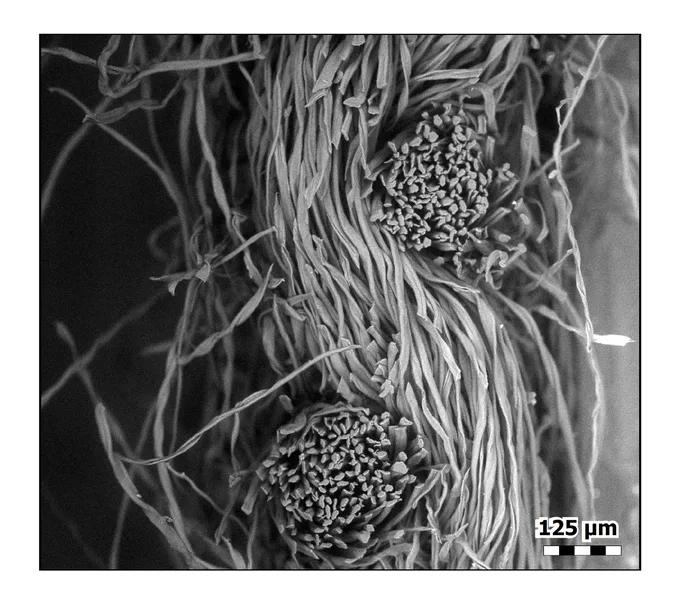
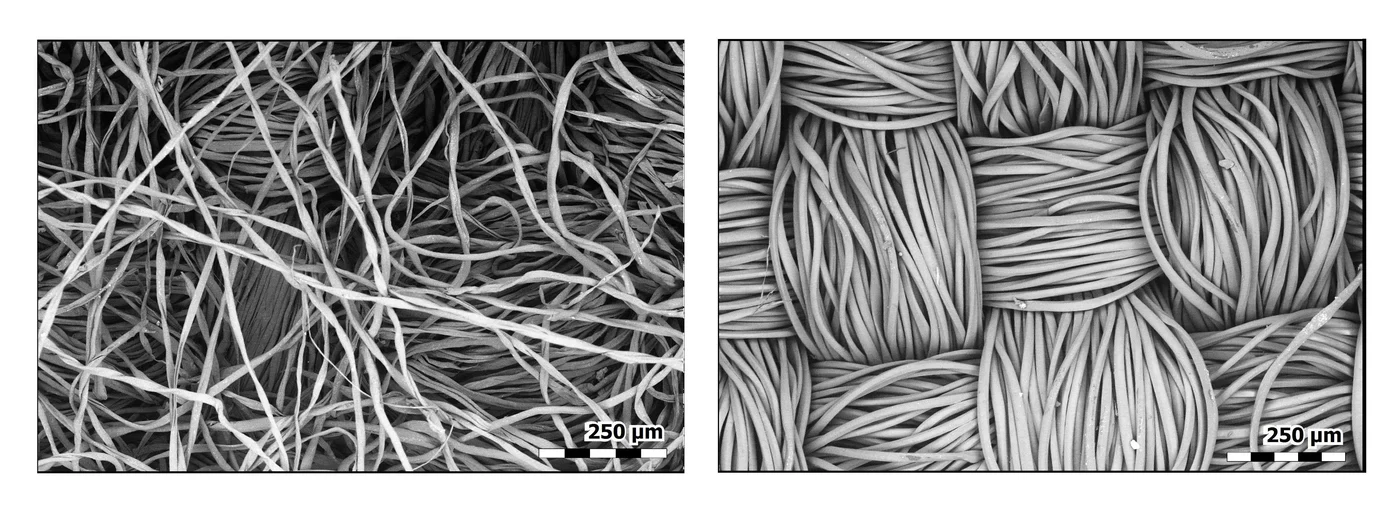
Look back at the two microscope images above. On the flannel, stray fibres cross the gaps between yarns. In the polyester specimen you can follow the outline of each bundle. The side view shows something the overhead picture hides: some of the cotton fibres stand proud of the cloth. That raised layer, or nap, is the first thing a fingertip meets.
It would be easy to caption the first image “soft” and the second “not soft”. But the pictures show geometry, not a verdict from anyone's skin. Someone who likes a velvety surface might prefer the first; someone who dislikes the way a nap catches when stroked backwards may prefer the second. A tightly woven cotton without a nap is a different comparison again.
Why can one cloth feel cooler in the first second?
Two cloths can spend the night in the same room and feel different the instant you touch them. What your hand notices is not just the temperature they started at, but how quickly heat leaves warmer skin at contact. The distinction matters: “cool to the touch” is not the same claim as “keeps me cool all afternoon”.
In sensory tests on warm and cool touch, researchers compared people's ratings with the initial peak in heat flow from a heated plate into a fabric. The two were closely related in the samples they tested. The instrument measured that early exchange, not the comfort of a shirt worn through lunch. At home, compare two dry cloths side by side on the same tabletop, not one fresh from the ironing board and one from a drawer. Notice which feels cooler first and whether that is still what you care about after a few breaths.
What changes between a sleeve and a tablecloth?
A shirt bends at the elbow, pulls across the shoulder and slides back down an arm. Most of a tablecloth stays put. With your sleeves rolled down there may be no skin contact at all. Roll them up and the hem or the folded pad under the cloth might matter more than the metre of fabric under the plates.

Roger Barker and colleagues made blouses from the same plain-woven, 100% cotton fabric and changed the wash treatment, including softening and starching. The heavily starched blouse received the least favourable tactile ratings; the softened one the most favourable. Where people noticed the garment depended on the action: shoulder areas registered across the activities, and the forearm registered in a bowling movement. Nobody had to change from cotton to polyester for the experience to change. The researchers tested garments, not table settings.
| When | At the table | In a shirt |
|---|---|---|
| At rest | A small patch of wrist rests on cloth backed by a firm surface. A fold directly underneath is easy to feel. | Some areas lie against the body; others hang clear of it. A stiff shoulder seam can matter more than the front panel. |
| In motion | Reaching for the salt slides the wrist over a short stretch, sometimes across a raised border. | With every reach the sleeve changes shape and brushes past the elbow again. |
| With moisture | A wet ring from a glass can change one patch while the rest of the cloth stays dry. | Moisture can stay in contact over a larger area. A dry fingertip test tells you little about a damp sleeve. |
A napkin is the useful exception. You lift it, fold it and bring the hem to your mouth. A rough edge that never troubled your forearm on a tablecloth can be the first thing you notice on a napkin cut from exactly the same bolt.
Why does a damp forearm sometimes drag?
Think about lifting your arm after a long conversation on a warm evening. If the skin seems to catch, that sensation is not a reliable way to identify polyester. In a forearm-friction study, Lutz-Christian Gerhardt and colleagues used one plain weave: 50% cotton, 50% polyester. Twenty-two adults took part. The researchers measured the resistance as the inner forearm slid over the fabric under a controlled load.
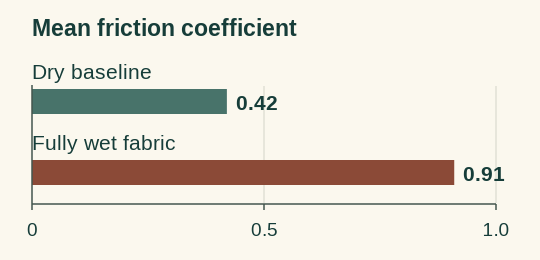
The mean coefficient was 0.42 with the dry textile against skin in its usual condition, and 0.91 in the fully wet fabric condition. That is more than double for the same weave. A hospital fabric soaked for an experiment is not a wrist beside a cold water glass, so the numbers are not a prediction for dinner. They do tell us why a dry patch and a clammy patch can feel like different materials. Nor is this a test of allergy or skin irritation: a measurement of friction does not establish either.
A two-swatch test at your own table
A cotton pillowcase and a clean piece of polyester cloth will do; they need not be new. If you compare a knit T-shirt with a woven tablecloth, the result may still be useful to you, but it will be about those two objects, not proof about their fibres.
- Hide the labels. Lay both pieces face up, dry and at room temperature, over the same edge with the same backing. Leave hems out of the first comparison.
- Rest, then slide. Touch each briefly with the same bare forearm. Note the initial coolness, then rest your arm as you would between bites. Reach once across each. Which feels smoother? Which catches?
- Change one thing. Turn each piece a quarter turn and repeat, or put the hem under your wrist instead of the middle. If your preference changes, the direction or edge matters to you.
- Reveal the labels last. Write down two separate answers: “I'd wear this as a sleeve” and “I'd lean on this at lunch”. You need not choose the same piece twice.
For spills, creases or what changes in the wash, the everyday comparison of cotton, linen and polyester takes up those separate questions. For touch alone, the useful verdict is smaller and more personal: I like this surface, in this place, doing this job. That tells you more about your next lunch than “100% cotton” ever could on its own.