
Are cotton and linen tablecloths better than polyester?
No. Cotton and flax linen generally absorb more moisture than polyester; polyester generally recovers from creases more readily. Neither fact tells you whether coffee will reach the wood underneath, or how the cloth will hang at the corner. For those answers, look beyond the fibre to the way the cloth is woven, finished and washed.
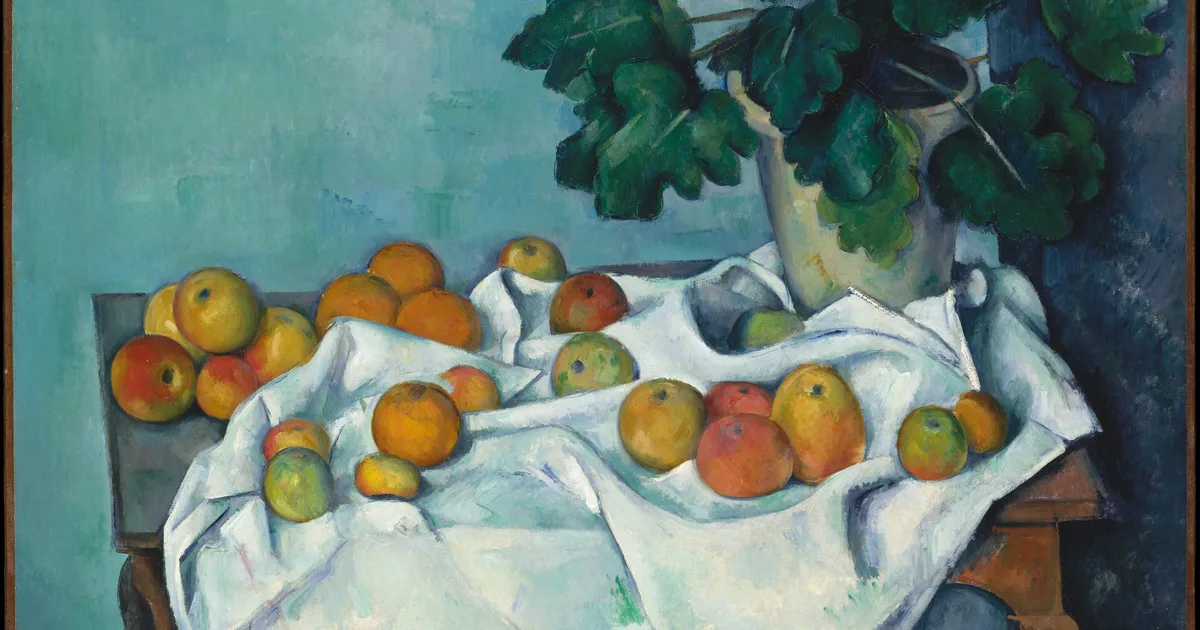
A tablecloth is not a napkin
When a glass tips, you can pick up a napkin with one hand. You cannot pull the tablecloth out from under six full plates. Absorbency is an easy virtue to recognise in the first piece of fabric. In the second, it is a trade-off: the cloth may catch the puddle before it reaches someone's lap, but now there is a wet patch on the table. Deciding which inconvenience you mind is more useful than deciding which fibre is more luxurious.
Cotton is the fine hair around a seed; linen comes from the stem of the flax plant. Both take up moisture, but a smooth linen can feel cool and crisp where a brushed cotton feels soft. Neither fibre springs readily out of a sharp fold. Polyester takes up little water into the fibre and generally recovers from bending more readily, but oily marks can cling. The Canadian Conservation Institute describes fibres and fabric structures separately for good reason: a fibre is the raw material, not the finished cloth. The University of Georgia's guide to textile fibres also distinguishes natural characteristics from what a finish can change.
| Fibre | Why choose it | Trade-off |
|---|---|---|
| Cotton | A soft cotton feels comfortable under a bare forearm. An absorbent cloth catches condensation from a cold jug. | Once the patch is wet it can transfer moisture to the table. A cupboard crease may still show after unfolding. |
| Flax linen | A cool hand, a slight lustre and broad, visible folds can be the whole point of a plain setting. | The same cloth may need pressing for a crisp, formal table. If you like the folds, there is nothing to fix. |
| Polyester | Crease recovery matters when a cloth comes straight from a drawer to a table set for supper. | Wrinkle resistance is not stain resistance. Oil can linger, and high ironing heat can damage the fibre. |
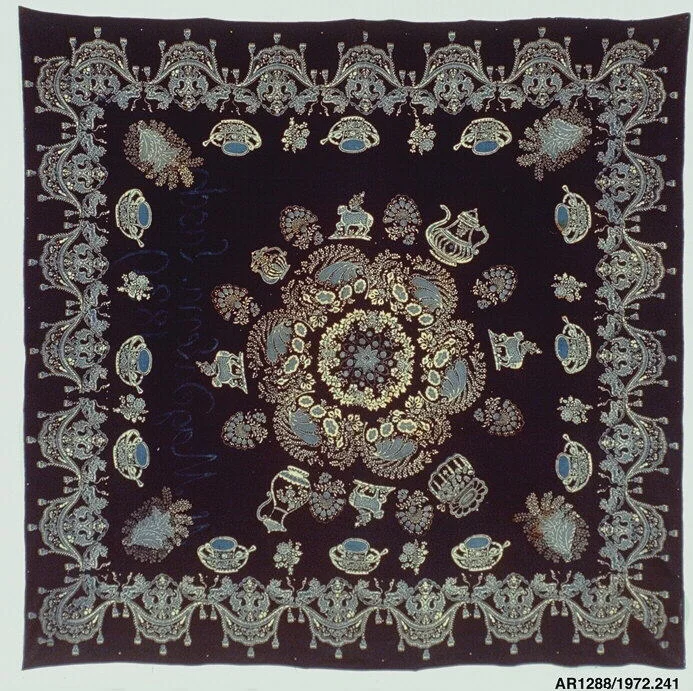
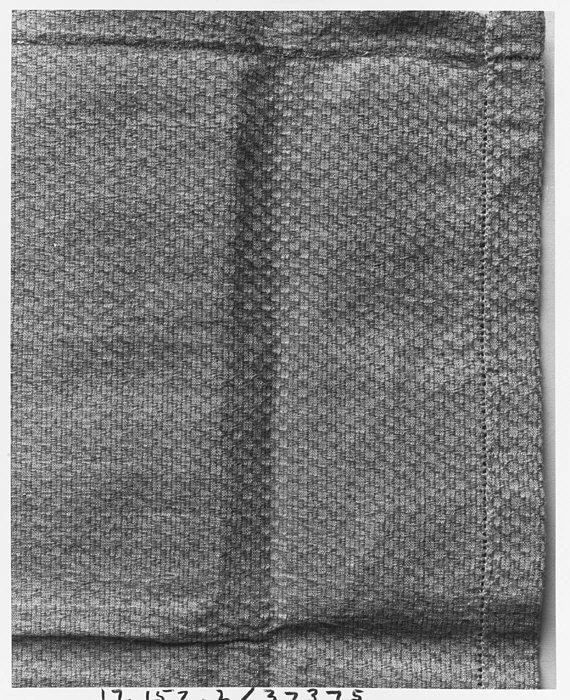
The two objects are shown at different scales. All three museum images: The Metropolitan Museum of Art, Open Access (CC0).
The tablecloth has an elaborate print and no flax at all. The napkin contains both linen and cotton. Neither object's appearance gives away its fibre content, a useful caution when a modern label says “linen-look”. An open weave and an uneven yarn can suggest linen to the eye; only the composition tells you whether there is flax in it.
Where does the water go? What happens to the oil?
A drop of water sitting on a cloth tells you one thing: the surface did not wet immediately. It does not tell you whether a whole glassful will pass between the yarns. Three things often get called “stain resistance” at the dinner table: liquid beading on top, liquid not reaching the wood, and a mark disappearing in the wash. Each has a different test. Polyester's low absorbency does not close the holes in a weave; a thirsty cotton cloth can hold a puddle and still leave a wet ring beneath it.
In a 2014 experiment on soil release, Guneet Dhiman and Jadu Nandan Chakraborty took the same plain-woven cotton, applied two different finishes and tested mustard oil and hot coffee. After laundering, both finishes released the mustard oil well under most of the conditions tested; the coffee still left a visible mark. The researchers tested neither linen nor polyester. What the experiment shows is more interesting than a winner: even when the fibre and weave stay the same, success with one stain does not predict success with the next.
To see the difference at home, lay a washable offcut over white kitchen paper on a plate and add a few drops of water. Look at the underside as well as the surface. A damp mark on the paper answers the question about this spill, not the question about tomorrow's salad dressing. There is no need to stain a good cloth on purpose. If a spill has already happened, the care notes on wine, grease and wax explain why the first step depends on what landed.
Does a heavier tablecloth hang better?
Picture two white cloths, the same size, falling over the same square corner. One rounds the edge in soft folds; the other sticks out far enough to brush your knee. Even if they weigh the same, they need not hang alike. Grams per square metre (gsm) tells you how heavy an area of cloth is. It tells you nothing on its own about how much effort it takes to bend it.
Harumi Morooka and Masako Niwa measured drape and mechanical properties in 138 woven fabrics. The measure most closely associated with drape in their samples combined bending rigidity with weight per unit area. They also measured bending along the lengthwise yarns, across them and on the diagonal. This was a study of how cloth falls, not a ranking of tablecloth fibres. It explains why the heavier of two cloths need not be the one that hangs closer to the table leg.
Try turning a square cloth an eighth of a turn on the table, so the yarns meet the edge on the diagonal. Keep the amount hanging over the edge the same, and look from chair height. Do the folds change width or stand farther out? This is an observation about that cloth, not a way to identify the fibre. It also explains what a photograph taken from directly overhead leaves out.
What changes after washing: the crease or the cloth?
A line down the middle and a hem that sits higher are different problems. The line may be an ordinary storage crease; a shorter drop can mean the cloth has changed dimensions. Pressing a crease is not the same as getting the original length back. To tell the two apart, measure the cloth flat and dry before and after its labelled wash and dry. Measure in both directions: the lengthwise and crosswise yarns need not change by the same amount.
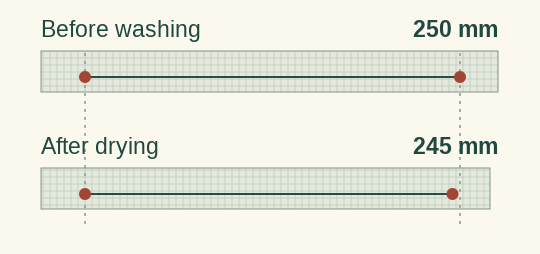
What does that look like at dinner? On a table 150 cm long, a centred 200 cm cloth has a 25 cm drop at each end. If the finished cloth measures 196 cm after washing, the drop is now 23 cm, not 21: the four missing centimetres are shared between the two ends. It is the length that actually hangs below the edge that a seated guest notices, not the percentage.
A soft cotton check that goes straight from the drying rack to breakfast may be easier to live with than a polyester cloth that needs a second treatment for oil. An unpressed linen may be the simplest of all for someone who likes its rumples. Someone else wants a smooth surface for a formal setting and will value crease recovery. Calling one fibre “easy-care” makes little sense until you know which of those jobs the household is trying to avoid.
Is a natural tablecloth always the greener option?
No fibre name settles the environmental question. Cotton and flax use farmland; water demand depends in part on where and how the crop is grown. Conventional polyester uses fossil resources, and synthetic textiles can shed plastic microfibres during use and washing. These are different impacts. Lower water use in one production stage does not cancel out plastic shedding in another, or tell us how long either finished cloth will last.
The European Environment Agency's textile life-cycle analysis also considers how textiles are made, maintained and kept in use. A fair comparison between two particular tablecloths would need that history, not just their fibre percentages. An heirloom linen used every Sunday and a polyester cloth already in daily rotation both have one advantage over a replacement: they are already in the cupboard.
So start with the meal, not the label. For cold glasses on a breakfast table, absorbency may be welcome. For a plain Sunday setting, the folds in flax linen may be all the decoration it needs. For a table that has to be set again in an hour, crease recovery earns its place. The best clue may be the clean cloth you reach past the others to unfold.
Printed polyester has its own small pleasure: in this teal and gold fan pattern, the fans open across the tabletop and slip out of sight in the folds.