
Polyester, cotton or linen: which makes the best printed tablecloth?
For a printer using heat-transfer sublimation, polyester is the natural choice. For a table set with printed flowers, all three fabrics are contenders. The difference starts with how the colour gets onto the cloth and ends with what happens after dinner.
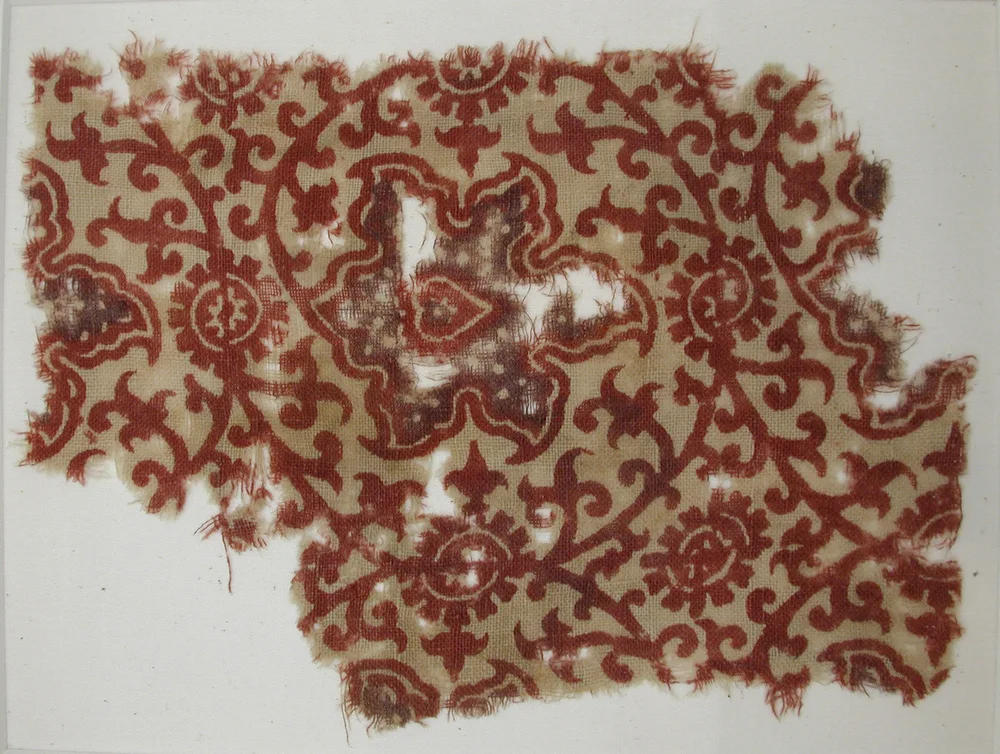
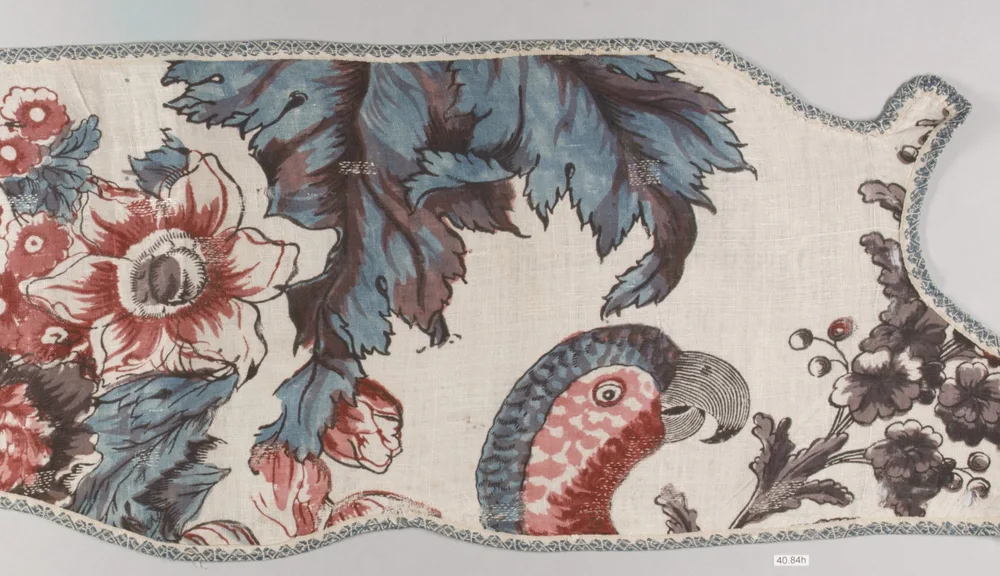
Museum photographs: The Metropolitan Museum of Art, Open Access (CC0). Shown at different scales.
Can you print on pure cotton and linen?
Yes. Look at the red curls in the first photograph. A printer in Gujarat made that repeat on plain-weave cotton using carved blocks and a mordant, a substance that helps bind a dye. The pale spaces between the red lines are as much a part of the design as the colour. In the second photograph, a Portuguese maker printed large leaves and a flower onto linen with blocks. Neither maker needed polyester to draw a clean, recognisable motif.
These objects answer a narrow question: can the fibre carry a print? They cannot tell us whether a modern tablecloth will survive a weekly wash or release a spot of olive oil. For that, separate three decisions that a shop photograph rolls into one: the fibre, the way its yarns are woven, and the way the colour is fixed.
Three ways to fix the colour
“Digitally printed” describes how a printer places the image, not what holds the colour in place. A useful question for a maker is: what ink was used on this particular fabric?
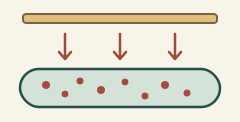
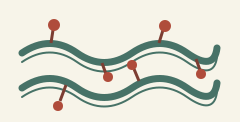
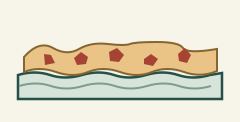
Reading the diagrams: red marks show colour, green represents fibre and gold is the transfer paper or binder. These are schematics, not microscope images.
Polyester: the transfer route
In conventional transfer sublimation, the pattern is first printed onto paper. The paper meets the cloth under heat; the disperse dye moves from the paper into the polyester. There is no layer of pigment binder needed to hold that image on top. That is a good reason to choose polyester if this is the printer you have. Feed it untreated pure cotton or linen and the same ink will not fix to the cellulose in the same way. The limitation belongs to the ink and process, not to the design. Mimaki illustrates the transfer and direct-print routes on the same machine.
Cotton and linen: use a dye that reacts with cellulose
Cotton comes from the seed hair; linen from the stem of the flax plant. Both contain cellulose. A reactive dye can form a chemical bond with it. In a typical reactive print, fixation and washing off the unfixed colour are part of manufacture, not chores for the buyer. The print does not need a separate pigment film. That can suit a soft dinner cloth with an all-over design, but the fibre name alone will not tell you whether the printer washed it off well. Epson describes the ink families and the fibres they suit.
Pigment: change the fixing method, not the fibre
A pigment is a coloured particle. A binder holds it to the textile surface, so a suitable pigment system can print across different fibres. Try bending a densely printed patch over your finger, then an unprinted corner of the same swatch. A difference in stiffness matters more at a hanging corner than it does in a flat product shot. Binder choice, the amount deposited and curing all matter; a pigment print need not be stiff. Cotton Incorporated's technical bulletin (PDF) explains the binder and its effect on feel.
One fibre, ten different linens
If fibre decided colour on its own, ten pieces of linen would give much the same result. In a 2021 colour-reproduction study, Tim Tofan and colleagues printed colour targets on ten linen fabrics with one Mimaki printer and one pigment ink system. Four fabrics were bleached, three were mélange (mixed-tone) and three were natural shades; their weights ranged from 125 to 280 g/m².
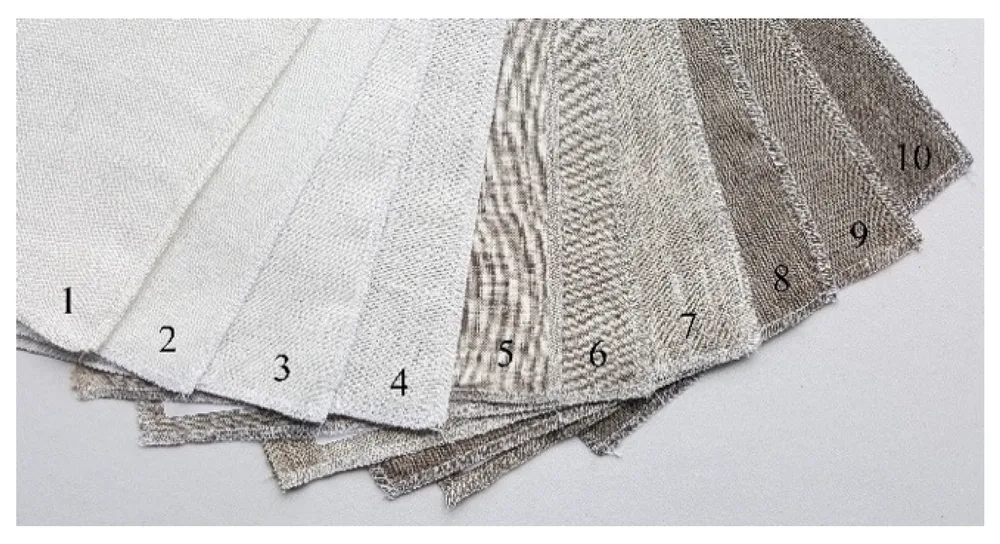
The printed colours on bleached linen came closest to the paper reference in that experiment. Rich blues and cyans were particularly difficult to match across the linens. The starting shades, thread counts and yarns differed: this was not a controlled contest between flax, cotton and polyester, nor a washing trial. It does give a buyer a better question than “Is linen dull?”: May I see my colours printed on the exact ground I will receive?
Think of a pale blue flower with an unprinted centre. Change the cloth from bleached white to oatmeal and that centre changes colour even if the artwork and ink file are untouched. A wider-spaced weave can also interrupt a fine outline where a yarn leaves a gap. A fine, smooth linen and a nubby cotton can reverse the effect you might expect from their labels. Compare a low-contrast detail as well as the largest, darkest bloom.
Which fabric earns its place at your table?
A cloth that lies flat straight from the cupboard and a cloth that takes up a spill are doing different jobs. These are starting points based on the University of Georgia's fibre guide, not performance ratings for finished tablecloths. A weave, coating or finish can change the result.
| Fibre | A reason to choose it | The trade-off to check |
|---|---|---|
| Polyester | Tends to resist creasing and takes up less water within the fibre. A useful starting point when you reset the table often. | Low water uptake is not waterproofing; liquid can pass between yarns. Oily dressing can cling even when water blots away. |
| Pure cotton | Absorbent and often pleasant against the forearm. A smooth, closely woven cotton is worth sampling for small leaves or lettering. | A spill can spread before you lift the cloth. Check post-wash measurements and pressing needs for the exact finish. |
| Flax linen | Absorbency and a visible weave can be part of the design. A broad motif can leave room for both pattern and texture to show. | Creases readily. A slub (a thicker section of yarn) may break a hairline border; not every linen has slubs. |
Read the border, not just the photograph
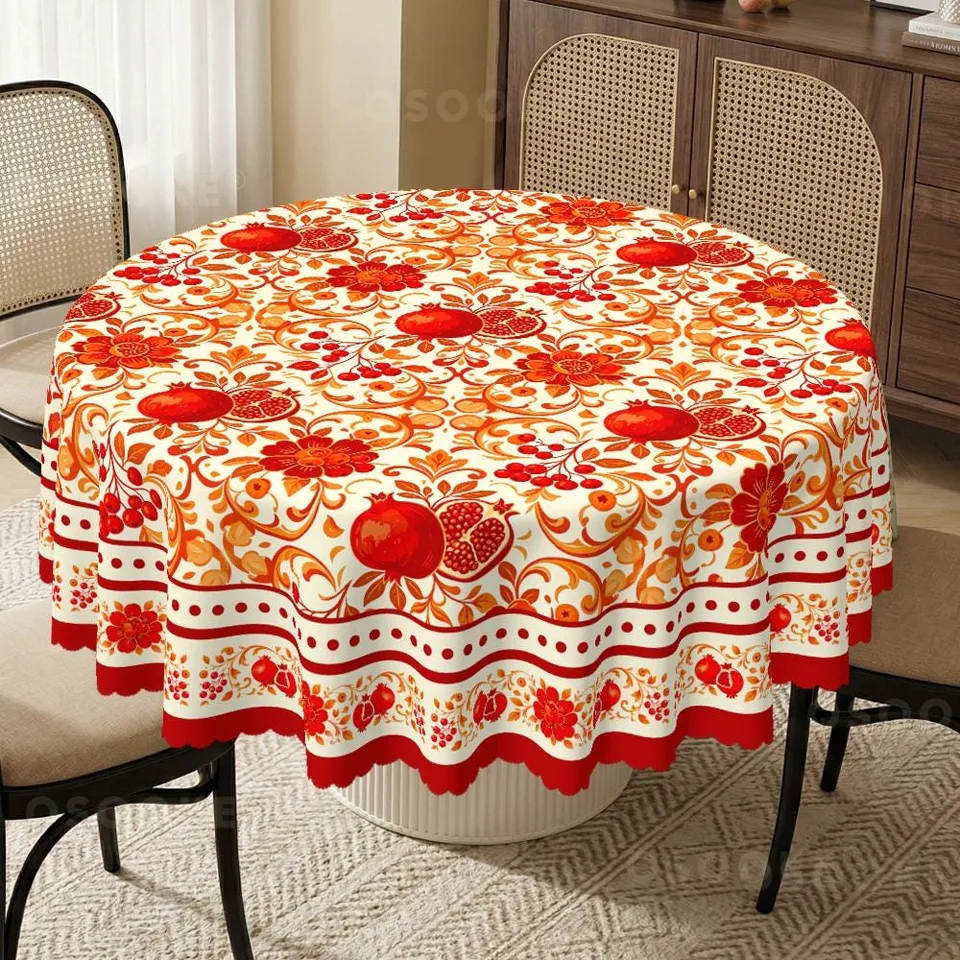
On our Mediterranean Pomegranate Floral Tablecloth, the big fruit reads from the doorway. The much better test for a fabric sample is the thin stem beside it. Can you still follow the line at your seat? Next, hang the sample over a corner. Does the border fall into a soft curve, or do you prefer a more pronounced fold?
The listing offers 120 gsm Peach Skin, 170 gsm Oxford Fabric and 280 gsm Canvas. On these HOLVERNE options, all three are polyester; “canvas” is not a promise of cotton. Our fabric guide compares the three weights. The listing is not evidence of which ink was used.
Decide which inconvenience you can live with
For a Sunday lunch where the cloth comes straight from the linen cupboard, choose an unpressed flax sample only if you like the folds under the plates, not just in the hanging edge. For breakfast with children, absorbent cotton is a reasonable choice if you are happy to lift and launder it after a spill; choose from samples that still fit after washing. For a venue resetting twelve tables, polyester deserves a trial if pressing is the bottleneck. Even three extra minutes of pressing per cloth would add 36 minutes per service. That is example arithmetic, not a measured time saving.
A swatch test that tells you something useful
Ask for a strike-off: a trial print of the actual design on the intended fabric. A generic colour chip cannot show whether a pale vein will disappear into this weave. Use two matching pieces you own or have permission to wash; keep one untouched. A home check helps you choose, but it is not a laboratory rating.
- Start with the same light and motif. Lay the pieces beside your usual plate. Compare the finest line, an unprinted gap and a dense area, first from your seat and then in evening light. Compare colour against the other swatch rather than a phone screen.
- Measure both directions. On the wash piece, mark two points along the length and another pair across the width. Record each distance. Follow the care label, dry as directed, let the cloth rest flat and measure between the same marks without pulling. Keep length and width results separate.
- Check for three different failures. Compare the washed print with the untouched one for colour change. Rub a spare dark printed area against clean white cotton, dry and then slightly damp, and look for transfer. On a separate scrap, try a small drop of your usual dressing and inspect after label-directed cleaning. Fading, rubbing colour and an oily shadow are three different observations.
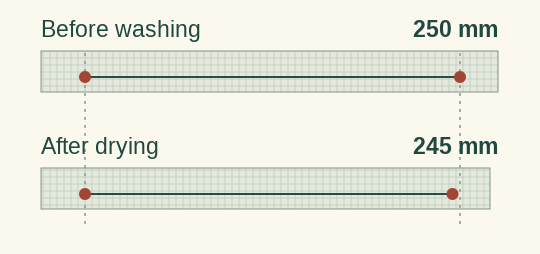
What does 2% mean at dinner? Suppose a 200 cm cloth is centred lengthwise on a 160 cm table. Its drop is 20 cm at each end. If the length shrinks by that illustrative 2%, the cloth becomes 196 cm and the two drops become 18 cm each. For a border that just clears a chair arm, those two centimetres are worth checking.
Ordering for a venue? Ask the supplier for results on the finished print, including the care cycle and the test used. The AATCC methods index distinguishes rubbing transfer (TM8), laundering colourfastness (TM61), dimensional change (TM135) and oily stain release (TM130). A result for one does not answer the other three. We have not run a comparative lab test on these cloths.
Keep reading
How much cloth should hang past the table?
Use the dimensions you expect after care to work out the drop on a round or rectangular table.