
Thin or thick tablecloths: what changes at dinner, and why do sellers care?
Thickness changes the bulk at a table edge and in a fold. It does not, on its own, tell you how much wood grain will show through or how the corners will hang. Online sellers have a reason to favour a cloth that folds into a smaller parcel: sometimes a few millimetres change what it costs to store or send. That is an incentive, not evidence that most sellers prefer thin cloth.
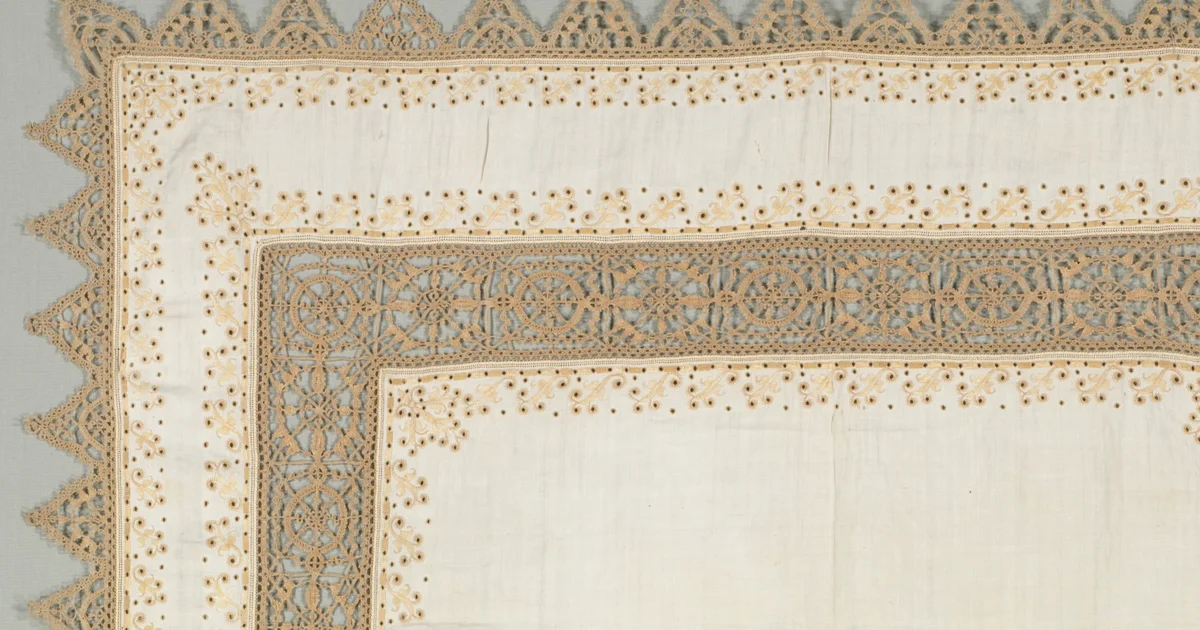
Can the lightest fabric also be the thickest?
Yes. Thickness is the distance between the two faces of the fabric, usually reported in millimetres. Press down on a fluffy weave and that distance changes; ASTM's thickness test explains why the pressure used in the measurement matters. GSM, by contrast, means grams per square metre: mass per unit area. A scale can tell you the second number but not the first. Neither is the depth of a folded cloth in a mailer.
Textile researchers Małgorzata Matusiak and Joanna Szpunar made three cotton fabrics from the same warp and weft yarns and gave them the same finish. Their 2025 paper reports both mass and thickness. Read across the rows, then look for the lightest specimen.
| Cotton weave | Mass per area | Thickness |
|---|---|---|
| Plain | 240 g/m² | 0.61 mm |
| Twill 3/1 S | 238 g/m² | 0.70 mm |
| Rep 2/2 | 242 g/m² | 0.58 mm |
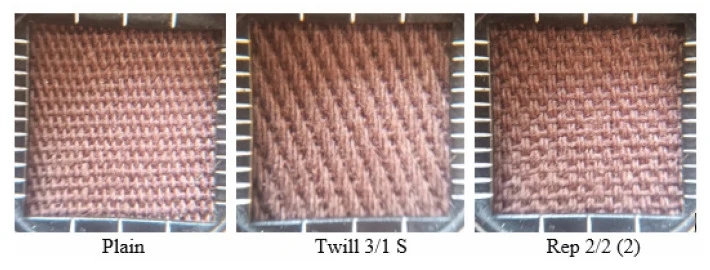
The twill weighed four grams less per square metre than the rep, yet measured about 21% thicker (0.70 versus 0.58 mm). The study concerned moisture transport, not tablecloth sales or quality. Its value here is that a single controlled example disproves the shortcut “higher GSM always means thicker”. It gives no reason to replace it with “twill is always thickest”.
What does thickness change on a real table?
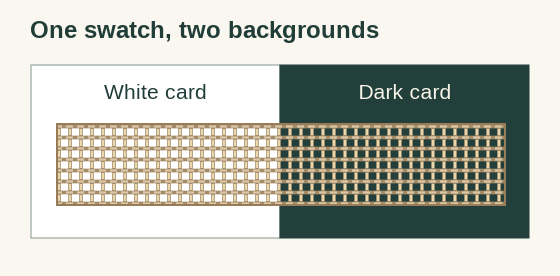
What shows through. On a dark oak table, a pale print can pick up the colour of the wood. Part of what you see comes down to the gaps between yarns, not just the height of the fabric. A microscope study of 24 woven samples found density and weave important to the measured open spaces; lighting also affected the image analysis. It measured pores, not how white a tablecloth will look at dinner. The practical test is simpler: slip a white card under one half of a swatch and a dark card under the other, lay it flat and look from a dining chair. Holding it up to a window answers a different question.
How the corners fall. A supple cloth can turn a square corner in several narrow folds. A stiffer one may stand out far enough to brush a knee. Weight helps pull a cloth down, but the weave also has to bend: measurements on 138 woven fabrics related drape to bending rigidity relative to weight. Compare two samples with the same length hanging below the edge. Otherwise an extra ten centimetres of drop can masquerade as a difference in fabric. For a closer look at the fold itself, see what makes a tablecloth drape or stand out.
What sits under your hand and your glass. Run a hand from the single-layer centre to the turned hem. Extra layers can soften the feel of a join in the tabletop and still create a ridge in the wrong place. Put an empty stemmed glass on the spot where a guest would actually set it. If the base rocks across embroidery or a folded seam, moving the border can solve more than changing the whole fabric. Thickness on its own promises neither a waterproof barrier nor protection from a hot pan.
What dries in time for the next meal. A lighter cloth is easier to lift out of the washer only if it is also lighter when wet. What happens on the rack matters too. In a drying experiment on clothing fabrics, blocking evaporation from one face with an unheated support lengthened drying time for every sample tested. Those were not tablecloths, so there is no minutes-per-millimetre rule to borrow. For a fair kitchen comparison, use the same wash and spin, then hang both cloths open; do not compare one doubled over a rail with the other spread out.
What fits in the cupboard. The bulk you store is the bulk of the folded piece, hems included. Two cloths with the same single-layer measurement may stack differently if one traps air and the other lies flat. If you keep four for a weekly change, try stacking four after laundering rather than judging one neatly pressed corner. The same distinction matters on a warehouse shelf.
Why might an online seller stock the lighter or flatter option?
Picture a seller offering one motif in six colours and three sizes. Each additional unit occupies a shelf position or part of a carton before anyone buys it. If base fabric is bought by the kilogram at the same price per kilogram, a lower GSM reduces the material cost for the same cut area. But printing the design and hemming its perimeter do not disappear. A fine, tightly woven lightweight cloth can cost more to make than a bulky basic one. The clearer incentive is often the one the seller can check with a ruler and a scale:
- Amazon UK, when Amazon fulfils the order. Its FBA pricing guide ties the per-unit fulfilment fee to product type, dimensions and weight. Monthly inventory storage is based on the average daily volume of the properly packaged units. A flatter pack may save storage space even if its fulfilment fee does not change. This is not how every independently shipped Amazon order is priced.
- Etsy, for eligible US and Canadian shops. With calculated shipping, the locations, item dimensions and weight feed the quote, along with the chosen package and service. A smaller package can give a buyer a lower delivery quote; it does not follow that the seller keeps that difference as profit. Fixed-price shipping is a different arrangement.
- eBay, when using calculated postage. The US seller shipping calculator asks for package type, dimensions and weight. It does not ask how many millimetres the unfolded fabric measures. If two packed options stay in the same applicable size and weight band for the same route and service, slimming one down need not change the postage at all.
Even before postage changes, a repeated difference can add up. For example, 100 rectangular packs with a 32 × 23 cm footprint take up about 29.4 litres less at a depth of 2.4 cm than at 2.8 cm (32 × 23 × 0.4 × 100 = 29,440 cm³). That is a geometric illustration, not an Amazon invoice or a promise that another 100 pieces will fit: master cartons, packing gaps and time in storage still count.
A UK parcel test: when do four millimetres matter?
Suppose one cloth uses 2.80 m² of fabric, including the fabric turned into the hems. At 150 g/m² that is 420 g; at 250 g/m² it is 700 g. Add an assumed 60 g per unit for thread, label and all packaging and the model gives 480 g and 760 g. That tells us what to put on the scales. It tells us nothing about the depth of the sealed pack, which must be measured separately.
For a specific boundary, Royal Mail's UK domestic size guide lists a Large Letter maximum of 35.3 × 25 × 2.5 cm and 750 g (checked 27 November 2026). Both the dimensions and the weight must fit. Assume a 32 × 23 cm footprint for each of the following three sealed packs. These are invented examples for the calculation, not measurements of products.
| Sealed pack | Weight and depth | Large Letter size/weight result |
|---|---|---|
| A: flatter fold | 480 g; 24 mm | Fits both limits, with just 1 mm of depth to spare. |
| B: bulkier fold | 480 g; 28 mm | Too deep by 3 mm, despite weighing the same as A. |
| C: heavier fabric | 760 g; 24 mm | Too heavy by 10 g, despite being as flat as A. |
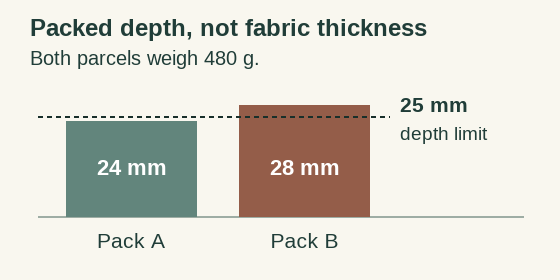
A seller with pack B might first try a different fold that spreads the hems instead of stacking them. A seller with pack C cannot remove ten grams by folding more neatly. And a pack with a one-millimetre margin is a poor candidate for guesswork: the thickest point after sealing, not the flattest point under a hand, is the one to check. Sometimes the most economical change is to the package, not the tablecloth.
Do most sellers actually prefer thin tablecloths?
The public evidence supports an incentive, not a majority. The platform documents explain costs. They do not report how many tablecloth sellers choose each thickness, what buyers receive, or which cloth sells best. A page of search results is no substitute: one design can appear in many colours and sizes, and a listed “item weight” is not a single-layer thickness measurement. Disposable party covers and washable woven linens are different markets, too.
There are sound reasons to go the other way. For a pale banquet setting over mismatched dark tables, opacity might be worth a larger parcel. For a household that wants neat folds on a small breakfast table, a low-bulk cloth may be the better textile even if postage is identical. And the Dutch market information agency CBI distinguishes price-led segments from those that pay for materials, design and workmanship in European table linen. A seller serving the latter has little to gain by saving on the outbound parcel if customers send it back because the wood grain shows through.
For your own table, try the contrast card, hang the corner and set down a glass. For a seller, add one more step: pack the actual size and weigh and measure it. Those two sets of tests can give different winners without either being wrong. For a related comparison of what changes with the fibre itself, see cotton, linen and polyester at dinner and in the wash.