
What makes a tablecloth drape well instead of sticking out?
At dinner, you notice drape at knee height: one cloth falls beside your chair; another hangs out like the brim of a hat. The difference is how readily the fabric bends and how freely its yarns change angle under the weight of the overhang. Thickness and grams per square metre tell only part of that story. A good place to start is the one view often missing from an online listing: the corner, seen side-on.
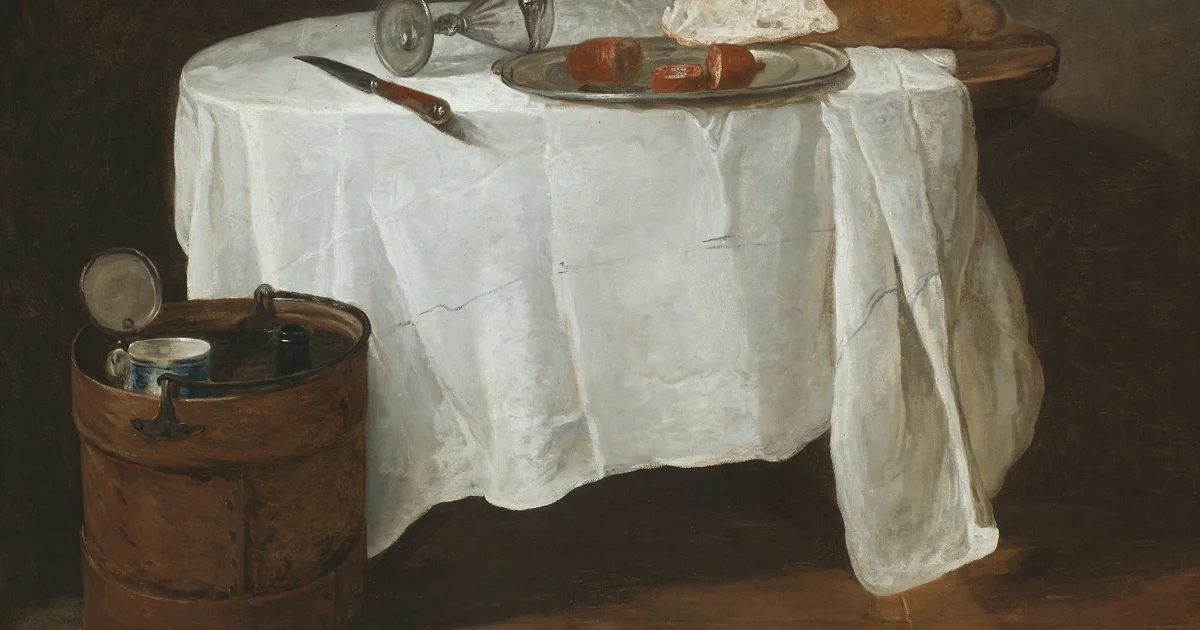

Why does one tablecloth turn the edge while another makes a shelf?
Look at the middle of a table edge first. A strip of cloth comes to the end of its support. Its own weight pulls it down; its resistance to bending keeps it pointing out. A light cloth that takes very little force to bend can turn almost at once. A heavier cloth may carry itself several centimetres into the air before it curves. A heavy supple cloth can fall beautifully, too. Add weight without adding much stiffness and gravity has the advantage. Add a stiff backing instead and the corner may stick out further, not less.
This balance has been measured. In Harumi Morooka and Masako Niwa's study of 138 woven fabrics, bending rigidity in relation to weight per unit area was more informative about drape than weight alone. A thin strip hanging over a ledge illustrates the idea: ASTM D1388 includes a method that lets a strip bend under its own weight. A strip, however, has no table corner to get round.
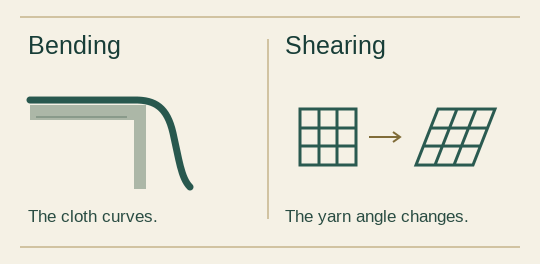
At a square corner, cloth from two adjoining sides has to go somewhere. The yarns can turn a little where they cross: imagine pushing a square grid sideways until the squares lean into diamonds without stretching the lines. Textile engineers call that shear. If the yarns can shift angle readily, fabric can gather into folds; if they resist, it may form a broad wing. Slide your palm along the top and you are judging surface feel. Let go of the corner and you are judging bending and shear together. A smooth surface can still belong to a stiff cloth.
Almost the same GSM, more than twice the drape coefficient
A useful counterexample comes from N. Kenkare and colleagues at North Carolina State University (PDF, Tables 1 and 3). They laid circular samples 36 cm across on an 18 cm support. Imagine looking straight down: the more cloth that sticks out beyond the support, the larger its projected area. The drape coefficient expresses that area as a percentage of the unsupported ring of fabric when flat. A lower number means the fabric fell closer to the support; it is not a lower mark for quality.
| Study sample | Mass and thickness | Mean drape coefficient (range) |
|---|---|---|
| Polytwill | 254 g/m²; 0.81 mm | 36% (35–40%) |
| Plain20 | 256 g/m²; 0.54 mm | 79% (73–85%) |
The thicker of the two fabrics fell closer in. A shopper comparing only their weights would see a difference of just 2 g/m²; a person looking at their silhouettes would see a much wider gap. These were different commercial fabrics, not an experiment in which only the weave changed. The result disproves a shortcut, not an entire family of weaves. Notice the ranges, too: even the same piece did not land exactly the same way each time it was laid down. One meticulously arranged product photograph cannot promise an identical fold on your table.
What do fibre, yarn and weave each contribute?
Fibre is the ingredient; yarn is what actually crosses the table. Cotton and linen are fibres; polyester is another. A mill can use fine or coarse yarns, group strands, or pack more yarns into a centimetre of fabric. A fine yarn in an open construction has room to move that a stout, closely packed yarn may not. That is why “100% polyester” can describe both a fluid cloth and a canvas that holds an edge. Equally, a crisp cotton shirting and a soft cotton voile do not contradict their labels. Neither fibre name is a promise of drape.
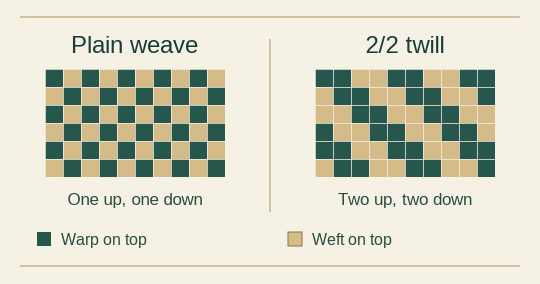
Weave tells you where the yarns hold one another down. In plain weave a lengthwise yarn, the warp, crosses over one widthwise yarn, the weft, then under the next. In a 2/2 twill it passes over two and under two; the pattern steps across to make a diagonal. The span before a yarn dives back under is called a float. With comparable yarns and density, longer floats can give the yarns more freedom. Satin weaves also use longer floats, spaced so they do not make the same diagonal. A dense trouser twill can still be firmer than a fine plain weave. CottonWorks' weave diagrams show the crossings, not a league table of softness.
Density changes the outcome even within a weave. In Gülcan Süle's weaving experiments, thicker crosswise yarns and closer weft spacing increased bending rigidity and the measured drape coefficient in the fabrics tested. A shopping label usually gives neither yarn size nor spacing. “Oxford” often refers to a grouped, basket-like construction; “Canvas” suggests body; “Peach Skin” describes a surface feel. Those names are useful clues, not a mill's weave draft or a measured stiffness.
The last processes matter, right down to the hem. A coating or backing can make a thin substrate behave more like a sheet. For some pigment prints the binder itself can stiffen the hand, an effect discussed in Cotton Incorporated's printing bulletin. That does not mean every print has a stiff binder. Compare a dense motif with a bare patch on the same finished sample. Then compare the single-layer middle with the stitched corner: layers turned back into a hem can hold a line the rest of the cloth would never hold. On a short drop, that band may be much of what you see.
Buying online: which photograph should you ask for?
Start with the dimensions, not the word “luxury”. Centred on a 35 × 50 inch table, a 55 × 70 inch cloth gives a 10 inch drop on each straight side and end: subtract the table dimension from the cloth dimension, then halve it. The diagonal from the table corner to the cloth corner is longer. That extra fabric makes a point which need not hang 10 inches straight down. A seller's floor-length photograph tells you surprisingly little about what the same fabric will do on your short drop. For other shapes, see our tablecloth size and drop guide.
- Ask for one continuous side view of the exact fabric. Start with the middle of a straight side and move to a free corner at chair height. Ask for the table and cloth dimensions, no clips, no table skirt, and no hand holding the fold. An overhead shot is good for checking the print; it removes the very silhouette you want to inspect.
- Watch the release, not the pose. In a short video, ask the seller to lift the hem a few centimetres and let it settle. Does the corner drop towards the leg, or does it keep a little shelf? Does only the hem kick out, or does the entire panel stand away? Ask whether the fabric was freshly pressed or has been washed according to its label. A pressed-in packing crease is not the same thing as a stiff weave.
- Compare like with like. Match the overhang, shape and variant. A long rectangle on a small round table is not a fair comparison with a short square on a large one. Nor is a beautifully draped photo of the light option evidence for the heavy option hidden in the same menu. A render can show scale and motif placement; ask for a finished-cloth photo if movement is the deciding factor.
- With swatches, turn the fabric rather than turning your head. Lay two samples of equal size over a book at the table edge, with the same length unsupported. Rotate each by a quarter-turn, then let a diagonal corner hang. Notice which sample comes closest to the book and whether that changes with direction. A small raw-edged sample can compare the base fabrics, but cannot reproduce a full-size hem. Ask to see the hem as well.
A message you can send: “I will have a 10 inch drop. Could you show that fabric at a square corner, without clips, lifting and releasing the hem once? Is that the same material as the option I have selected?” One clip answering those questions is worth more than six views of the centrepiece.
Why HOLVERNE kept 120, 170 and 280 gsm
We tested and handled fabric samples repeatedly before keeping these three. All three are 100% polyester. We did not want choosing a print to mean accepting just one kind of fold. Our impressions below are about how the finished fabrics feel to us. They are not laboratory drape coefficients, and the university samples above were not ours.
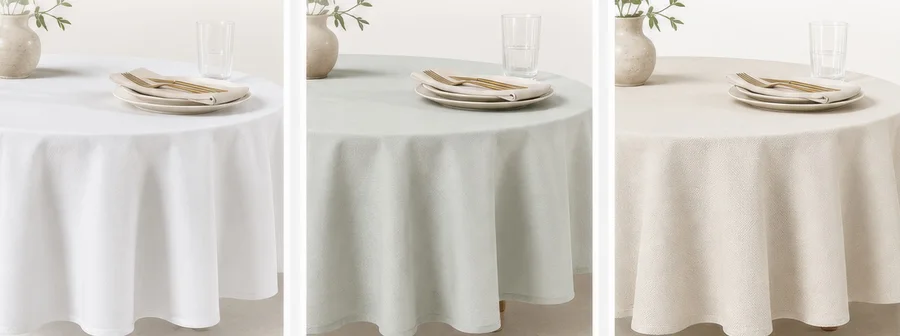
120 gsm Peach Skin: when we want the edge to get out of the way. What we like is the contrast between a smooth, soft fall and the hard edge of a wood table. For a small breakfast table or a print brought out for just one evening, we would choose this on its own merits, even if all three cost the same. If a deep, sculpted corner is the whole point of the setting, it is the body, not a higher price tag, that the light cloth cannot give you.
170 gsm Oxford Fabric: when the border is part of the drawing. This is the middle option in the hand, not just on the price list. We like some body under an illustrated border so that the motif is still legible as it turns the edge, without asking the cloth to look like a skirt. It gives the buyer who finds Peach Skin too fluid somewhere to go without taking on the texture or the price of Canvas. A design that needs a really loose ripple is still better served by the lighter option.
280 gsm Canvas: when the fold itself is part of the decoration. The appeal for us is a more substantial, textured edge. Think of a plain plate over a large print: a broad fold can give a motif room to read, even as a finer cloth might hide part of it in a narrow pleat. If the table lives close to dining chairs or the cloth has a very short drop, that extra body may be the opposite of what you want. Canvas here names a polyester fabric, not cotton content or a quality grade.
What does the extra money buy, and when would we keep it?
Hold the design and size still. In our Green and Gold Bow Christmas Tree design, a 55 × 70 inch rectangle was listed at the following US-dollar prices on . The fabric column is a calculation: a 55 by 70 inch rectangle covers about 2.484 m². Multiply by the stated GSM. These are not measured finished weights: hems, cutting allowance, labels and packaging are not included.
| Fabric | Fabric in the stated area, approx. | Listed price (USD) |
|---|---|---|
| Peach Skin · 120 gsm | 298 g | $32.99 |
| Oxford Fabric · 170 gsm | 422 g | $40.99 |
| Canvas · 280 gsm | 695 g | $55.99 |
Cost is not the same as price. At the same cost per kilogram, the heavier ground needs more money in yarn for the same area. Actual grounds need not cost the same per kilogram. The printed area and length of hem are broadly the same for these three rectangles; cutting, printing, sewing and packing still have to happen for the light one. Conversely, extra grams do not tell you what the mill charged, what the parcel cost or what margin a seller made. For the parcel question, see our separate study of thickness and packed size.
What feels worth paying for? In this example the move from Peach Skin to Oxford is $8; the next step to Canvas is $15. If you want a moving, unobtrusive hem, paying $23 more than the first price takes you away from the look you wanted. If you want a border to hold a stronger outline each time you dress the dining table, texture and body may justify the difference. That is what buyer acceptance means in our design decision: room for different tastes, uses and budgets, not a claim that one weight wins a popularity vote.
Our advice is to choose the corner you want first and the price you are happy with second. The Green and Gold Bow Christmas Tree tablecloth puts the three materials under the same print, so you can compare the fabric without also changing the pattern. Select your own size for the current price and availability.